Archive for DISC Model – Page 2

Most of my writing about how to use the DISC Model to communicate more effectively has been focused on verbal communications. While the tips still apply to written communication, I haven’t written specifically about how to apply the model in emails and letters.

I might expand this thought further in later posts, but, for now, I thought I would share a quick tip to improve the odds that people actually read and take action on your written correspondence.

This tip is pretty simple and straightforward:

Put the main points and conclusions in bullet point or really short paragraph form at the top of the email and all supporting information below it.

Here’s my thinking on this tip.

Outgoing, fast-paced people don’t usually want to wade through the details to get to the conclusion. They will likely skim your email and then miss or misunderstand your point if you bury it towards the end.

Reserved, slower-paced people will probably want the supporting information. And, even they will probably skim the bullets first to decide if reading the details is worth their time.

Do your reader a favor, get to the point and then support it. Don’t build a case and then conclude.

(So, what if you need to build a case before you give a conclusion? If that’s your situation, I would question whether email was the best way to do that particular communication.)

Last week, I saw a report on television about the number of children that have likely been misdiagnosed as ADD/ADHD. As I watched the television piece, I was reminded of a common problem I see when people start to apply the DISC model of human behavior.

Here’s the challenge:

People often use disorder descriptions to speak about normal behavior.

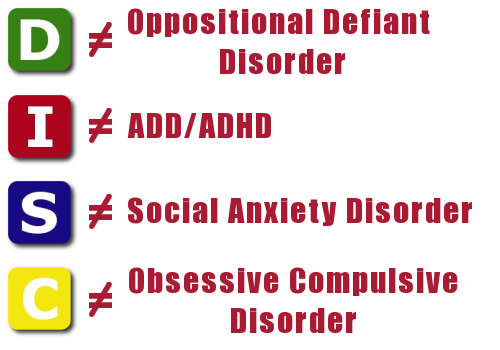
The  most common misdiagnosis I have observed are:

D behaviors described as if they are indicative of Oppositional Defiant Disorder.

I behaviors described as if they are indicative of ADD/ADHD.

S behaviors described as if they are indicative of Social Anxiety Disorder.

C behaviors described as if they are indicative of Obsessive Compulsive Disorder (OCD).

While it might seem funny to some people to use the illness descriptions to speak about normal behaviors, I don’t really find it that humorous. In fact, I find it a bit offensive for several reasons:

  • Using illness descriptions to speak about normal behaviors minimizes the frustration and struggle of people who do have the psychological condition.
  • Using an illness description to speak about someone who does not have the illness implies that their behavior is, in some way, bad or wrong rather than just driven by different perspectives.

If you have read much of my writing yet, you know that I am a strong proponent of using the DISC model as a way to better understand how another person might see a situation and how I might best adapt to connect with them. I hope you also see that I strongly disagree with any attempt to use the model to label or artificially categorize people.

Generally, I have seen illness descriptions used by people to describe other people with the opposite style. For example, people with strong Cautious traits saying that people with strong Influencing traits are ADD/ADHD. Or people with high Inspiring traits saying that people with strong Cautious traits are OCD.

If you want to use the model to communicate more effectively, connect with others faster, and to build better relationships, I encourage you to beware of the temptation to use illness descriptions for any of the four primary behavior styles.

One of the most common questions about using the DISC model is this: “How do I know another person’s personality style?”

Well, the short answer is: you can’t know another person’s style without assessment results.

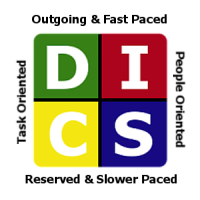
You can, however, make an educated guess about their primary style (or at least how they are interacting in the current situation) by observing their words and behaviors and answering two simple questions (phrased in the language of the DISC model):

  1. Are they more outgoing or more reserved? and
  2. Are they more task-oriented or more people oriented?

Or, stated another way:

  1. Do they speak more quickly, loudly and emphatically or more slowly, softly and monotone?, and
  2. Do they speak in more factual, “thinking” language or in a more relational, “feeling” language?

Answer those two questions and you’ve got your starting point for connecting better with them.

If they are:


Free DISC Profile

Task-oriented vs people-oriented

In one way or another, I have commented on this common difference between people in this blog and in other articles. It seems that I have, in many cases, made the point in an indirect way. Today, I thought I would make a more explicit observation about one of the common differences between task-oriented people and people-oriented people (from the DISC model):

  • Task-oriented people generally “think” about things (including relationships).
  • People-oriented people generally “feel” about things (including tasks).

In a previous post, I shared the story about calling home while I was traveling. That story illustrated my task nature and how I made a relational effort (calling home) into a task. That story also illustrated how the way that I defined the task led me to ignore the relational aspect of calling home. I called home and I was done. No conversation. No real listening. I checked out when my task (calling home) was checked off my list.

A similar mental barrier can creep into the approach that people-oriented people take with regard to tasks.

For example, I once worked with an extremely people-oriented person on evaluating a potential business investment. As we talked through his options, we came to a logical conclusion about what he should do next. After we came to our conclusion, he paused and said that he had some reservations about being able to invest the money needed to move forward.

I said: “How much money do you have?”

He said: “I don’t know for sure. I just don’t feel like I have enough.”

I wanted to say (but, thankfully, I didn’t): “How much money you feel like you have was not the question. I asked, how much do you have?”

At that moment, we could have had a major communication breakdown. He felt rather than thought about a factual, data-driven issue.

My colleague in this story is a very intelligent person. We did not get into a conflict over this situation because we were both able to adjust our communication styles (word choice, tone, etc) to better connect with each other.

What if, instead of holding back my initial thought, I had said what was in my mind: “…how much do you have?” (With the accompanying sarcastic tone.)

How would our relationship have progressed from that point?

I think it would not have gone well.

The misinterpretation of intent that often comes from this simple difference in perspective and approach can create some pretty intense conflicts.

Task-oriented people can think that people-oriented people are not rational.

People-oriented people can feel that task-oriented people don’t care.

And both assumptions are often wrong.

A Question to Ask of Yourself:
How do I better control myself?

I often hear people ask questions about the DISC model that indicate a desire to use the model to somehow change others.

Rather than using the model to label, categorize, or stereotype people, I suggest a different approach: use the DISC model to find ways to connect with other people in better, more effective ways.

Towards that end, one question that I suggest you ask yourself is this:

How can I use the DISC model to better understand other people and change my behaviors so that I communicate more clearly?

My message is pretty simple: get over yourself.

Learn to adjust and modify your words and actions so that they are heard and understood more quickly and more clearly by other people.

This is what I strive to do every day. I’m not perfect by any stretch of the imagination. The more I work at it though, the better I get. And you can do it, too.

Do this, and you will significantly improve your effectiveness as a leader, team member, or parent.


Free DISC Profile

0 Categories : DISC Model, Video