Archive for Post Series

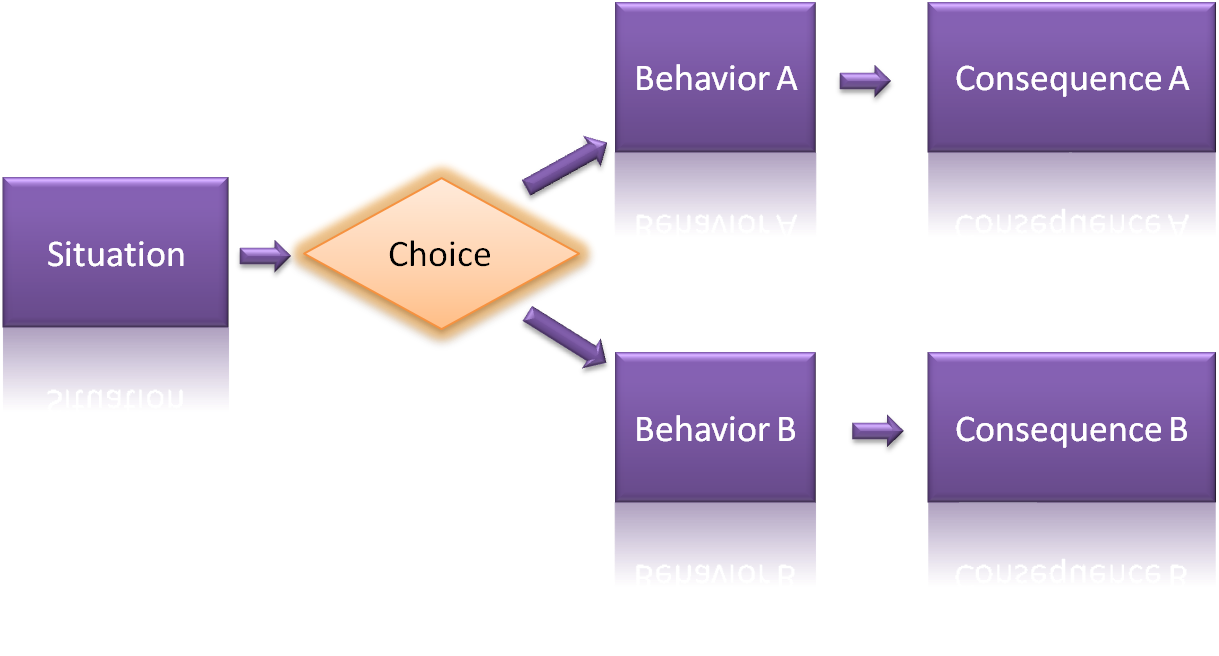
The diagram above shows a simplified model for better understanding what drives behavior.

Since people often spend their lives studying and understanding what really drives our behavior, I am pretty confident that I cannot hope to fully cover the topic in this short post.

I can provide a quick overview you can use to diagnose what’s happening in your interactions with other people and how you might be able to modify your approaches to get better results, have more fun, experience more satisfying relationships, and make sense of what you see people do.

Here’s a simplified description of what the model shows:

  1. We enter a situation.
  2. We anticipate the outcome we want from that situation.
  3. We choose the behavior that (we hope) gives us that outcome.

This description leads to the following implication:

We choose our behaviors based on what we expect to happen after we do them.

The consequence is what we expect that we will experience as a result of our behaviors. In this context, a consequence is anything that we experience as a result of our behavior. A consequence might be some external thing we receive or get because of our behavior. A consequence can also be the feelings we get from the behavior.

As you might guess, we tend to avoid negative consequences and to pursue positive consequences.  As a result, negative consequences (like punishments) tend to discourage repeating behaviors and positive consequences (like rewards) tend to encourage behaviors to repeat in the future.

Part of the challenge with applying this model in practice comes from a common error known as perception error. Perception error happens because not every person sees every consequence the same way. What one person sees as a reward; a different person might see as a punishment.

You can use the  DISC model to gain insights to avoid perception error.

For example, public recognition might be a reward for an outgoing, people-oriented person and it might be a punishment for a reserved, people-oriented person.

You can also apply the 5 Be’s of Motivation as you work with other people to encourage better interactions and results.

Remember, this is a very quick, very simplified description of this model and it’s implications. I’ll offer more insights in future posts.

Last week, I listened to a speaker talk about the necessity of becoming clear on your purpose if you want to achieve success. It was a message that resonated with me, and it triggered some thoughts about my business and my relationships.

As I reflected on what he had to say and I considered some of the questions I receive in workshops, seminars, teleseminars, and coaching calls, I realized that part of what I hope to accomplish with my work is to help people get free of thoughts, attitudes, and behaviors that trap them in bad situations — bad work relationships, bad personal relationships, bad partnerships, etc.

So, I’m starting a series of articles targeted at specific things you can do to take charge of your life. I haven’t mapped out a detailed plan at this point. The series might be 6 articles or 16. I don’t know right now. I’m just going to write them and keep adding to the series until it is finished.

The general principles that come to mind as I start are:

  • Control what you can
  • Influence who you can
  • Forget about the things and people you can neither control nor influence
  • Stay focused on what you can do rather than what you can’t do
  • Take responsibility for your situation.

I might think of some others as the series progresses. I would certainly be open to input on what to include on this list. Please let me know if you see a core, guiding principle for taking charge of your life that I missed.

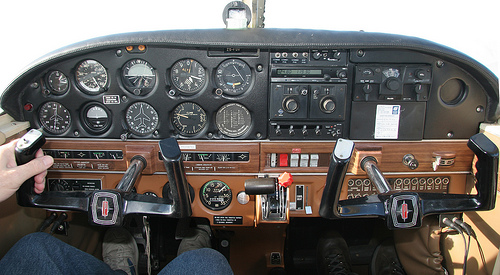
The general principles are sort of like the airplane control panel in the picture above. They give you a way of looking at and evaluating your life to see what you either need or want to change. I’ll be exploring each of them individually and some related ideas in future articles. I hope you’ll stop by again and check the series out as it unfolds.

Photo by Blyzz on Flickr.

This article is from the Take Charge series. Use the links below to read more from this series.

This series of articles contains specific tips, insights, and techniques for connecting with people better.


Free DISC Profile


This is a series of articles that answer frequently asked questions about the DISC model of human behavior.


Free DISC Profile