Archive for conversations

Communication Feedback Loop

The communication process really should be easy. You say something to another person. They hear it. They act in a way that is consistent with what you said. End of discussion.

And, it’s not quite that easy.

In reality, the process for spoken communication goes like this:

  1. You get a picture in your mind of what you want to communicate.
  2. You convert that picture into words, tone, and body language that describes the picture as you see it.
  3. The other person hears the words and notices your tone and body language.
  4. The other person converts the words, tone, and body language into a picture in their mind.
  5. The other person reacts to the picture as they see it.

The reason the real process doesn’t always go as smoothly as the ideal process lies in two key phrases: “as you see it” and “as they see it.”

The challenge in communication is that we often use words, tone and body language that mean one thing to us and something very different to another person. The difference might only be small, and still it is different. As the differences get bigger they can cause major miscommunications that result in wasted time, effort, and energy. In high-stakes or emotion-charged situations, even small differences can drive the conversation in a negative direction.

One way to bridge the differences between how you interpret a message and how another person interprets the same message is to include a feedback loop – you might say an understanding check – into your communications strategies.

As I wrote before, I am not a big fan of silver-bullet, one-size-fits-all communication techniques. I think you need to consider the whole situation before you apply any specific technique or tactic.

At the same time, I think there are some phrases and approaches you can add to your repertoire in preparation for high-stakes or emotionally-charged situations so that you can respond better when you are under pressure.

The communication feedback loop is one approach that I recommend in my private coaching sessions and in the communication workshops that I lead. In my last post, I wrote about the feedback loop in terms of how to apply it to make sure that you understand others more clearly. Today, I’m offering the other side of the communication feedback loop – checking the other person’s understanding of what you said.

In many respects, this side of the feedback loop is a bit more delicate than repeating back what you heard. In this case, you are going to ask the other person to tell you what message they received from your communication effort. Done poorly, asking the other person what they heard can come across as condescending or aggressive. So, you have to work extra hard to add more words, to soften your tone, and to choose non-threatening body language to make this work.

Here are six questions you can use to make sure you have communicated effectively:

  • “Would you please say what you heard me say, so I can be sure that I was clear?”
  • “So that I can make sure I communicated clearly, would you please tell me what you heard me say?”
  • “I just want to make sure that I am clear. Would you please tell me what you understood me to say?”
  • “I’d like to make sure I said that clearly. Please tell me what you heard?”
  • “I’m not sure that I am conveying my idea the best way. What have you heard me say?”
  • “I may have said that in a way that does not really communicate what I’m trying to say. If I did, I’d like a chance to rephrase it. What message did you hear?”

As I suggested in my post about the Five Questions to Make Sure that You Understand Others Correctly, I offer this list as a starting point for you to develop your own. As you develop your list, remember the underlying idea – if there was a miscommunication of any kind, you take the responsibility.

I’d love to see ideas you have for other ways to check understanding. Please add them in the comments section.

Before you start looking for the right communication technique or words to use to convey an idea, you must consider three critical factors. They are not complicated. They are important. Failure to include them in your thinking, could lead to a failed communication.

Proper consideration of these three factors coupled with understanding the underlying principles of communication and conflict resolution will lead you to successful, powerful, and effective communications.

The general principles, concepts, and mindsets of effective communication are simple to say. In fact, they pretty much reduce to:

  • Assume the other person has benign intent until you definitely learn otherwise.
  • Communicate in ways that do not project a threat to the other person.
  • Make it easy for the other person to receive your message.
  • Close the loop on your communications to make sure you understood correctly and that the other person understood you correctly.

This list is probably not inclusive of every key communication principle. It does include the basic, underlying ideas for most of the techniques and approaches that I teach in workshops, help coaching clients to implement, and that I work to apply in my personal life. They are simple enough to express, and they are often difficult to apply.

Application becomes difficult because of the three critical factors I mentioned above. The foundational principles and core ideas combined with the three factors accounts for the wide range of possible communication strategies you could apply in a given situation.

The three factors are:

Your Message

In many cases, this is the first factor that most people consider, and they often consider it only from their perspective.  If stated out loud, most people’s thinking would probably sound like this: “Here’s what I want to say.”

In reality, your message has two parts:

  1. The message you are attempting to deliver, and
  2. The message that the other person receives.

The second part of your message – the other person’s perception of it – is at least as important as the message you intend to deliver. As you choose your approach, make sure you consider both sides of the message.

Your understanding and consideration of the next two factors significantly influences how the other person receives your communication.

Your Relationship

The nature of your relationship with the other person must figure in your thinking as you communicate with him or her. While the general principles remain the same, the specific strategy for communicating with your supervisor is different from the strategy you would use with your colleagues or with people who report to you.

If there is a power mismatch between you and the other person, it could increase the perception of threat felt by either party. Keep this in mind as you plan your communications. If you are the “superior” party, you might have to work a little harder to take any subtly implied threat out of your communications.  If you are in the “subordinate” position, you might hear threats that are not intended.

The Context

Where are you during the communication? Is it spoken or written, on the phone or face-to-face, one-on-one or in a group setting? Each of these situations – contexts – calls for a different consideration as you choose your communication tactics and techniques.

The bottom-line is this: if you are looking for silver-bullet, one-size-fits-all communication strategies – look no further. You will not find them.

Work on building your communication tool kit, develop and practice multiple approaches and phrases to use in different situations and with different people, and learn to read situations so that you can choose the best communication tool for the job. Do these things well, and you will become a remarkable communicator.

As you look for the right tool for the job in various situations, remember the three critical factors to improve your odds of success.

Communication breakdowns are a common cause for conflict, and poor communication strategies can lead to rapid escalation. Likewise, effective communication strategies can help you correct these miscommunications to move conflicts quickly towards resolution.

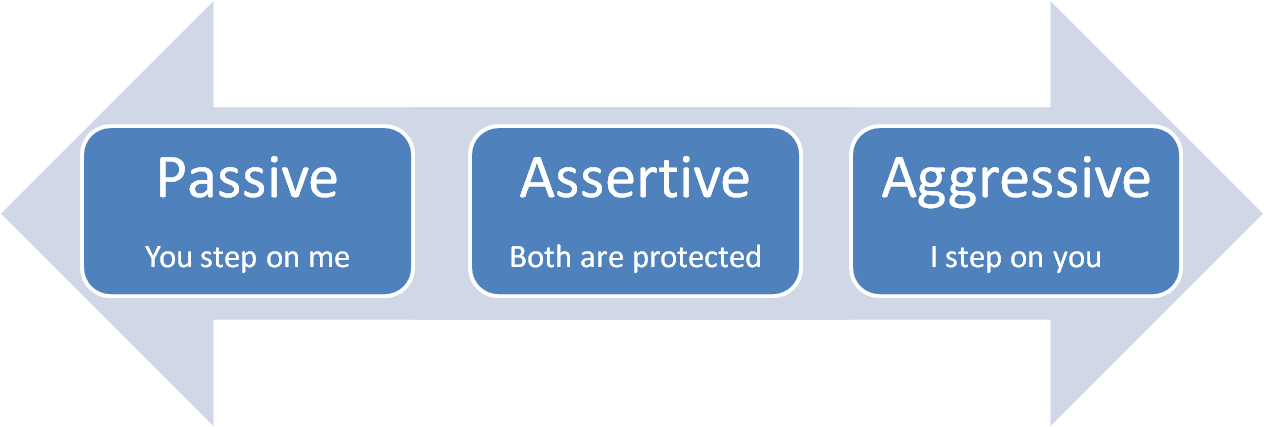
One idea that can help you choose the best communication strategy for the situation comes from what I call the communication continuum.

The continuum runs from passive strategies on the left to aggressive strategies on the right. In passive strategies, you communicate in a way that protects the other person’s interests at the expense of yours. Aggressive strategies represent the other extreme where you communicate in a way that protects your interests at the expense of the other person’s.

Assertive communication strategies lie in the middle. These strategies depend on approaches that protect the interests of both parties in the communication – yours and the other person’s.

Assertive communication approaches represent a range of techniques rather than a single point on the continuum. Some of the approaches lie a little to the left of middle – they are a little more passive – and other approaches lie a little to the right of middle – they are a little more aggressive. Wherever they lie on the continuum, all assertive strategies have this in common – the interests of both parties are protected. Depending on the situation, you might choose to go a little more passive or a little more aggressive within the assertive range.

Whether it sits a little left of center or a little right of center, the guiding principle behind all assertive communication techniques is that the technique allows you to effectively express your needs and concerns in a way that respects the needs and concerns of the other person.

Here are some guidelines for communicating assertively…

  1. Use “I” statements.
    State your perspective as your perspective or interpretation without resorting to statements that blame the other person. For example, “You made me angry”  is aggressive while “I felt angry” is assertive.
  2. Focus on behaviors.
    Avoid the desire to slip into interpretations like calling the other person rude or insensitive. Comment on their behaviors or words without labeling them.
  3. Keep your responses short.
    The longer you talk, the more likely you are to slip into either passive or aggressive techniques.
  4. Monitor your tone of voice and non-verbal messages.
    You can choose just the right words and ruin it with a sharp tone or aggressive posture.
  5. Listen.
    Pay close attention to what they have to say as well. If you do not listen, you will become aggressive.
  6. Maintain appropriate eye contact.
    Too little eye contact and you could be perceived as dishonest. Too much eye contact and you could come across as aggressive.  In most situations in North America, relatively steady eye contact with brief breaks every few seconds is probably appropriate.

Here are some ways you can apply the general guidelines to communicate assertively without slipping too far into either passive or aggressive communication:

  • “When you (their behavior), I feel/felt (your feeling/interpretation).”
  • “When you said/did (their words/actions), I understood that to mean (your interpretation).”
  • “I see/perceive (a behavior, tone, or word choice), to mean (your interpretation).”

Stuck in the pastToday, as I sat in an airport business lounge waiting for a flight, I overheard bits and pieces of another traveler’s conversation. I wasn’t trying to overhear. I just couldn’t help but overhear because his volume kept getting progressively louder.

From what I could tell, he was engaged in a bit of a conflict conversation.

I could also tell that he was making a common mistake that rarely, if ever, leads to conflict resolution and almost always leads to conflict escalation. Based on the bits and pieces of conversation that I overheard, I think the person on the other end of the phone call was making this mistake as well.

The symptoms of the mistake manifested as:

  • Justifying behaviors
  • Explaining why he was right
  • Showing the other person why he was wrong
  • Rehashing what had already happened
  • No focus on what to do the next time this situation occurred to make it turn out better

The root cause of the problem stems from focusing on the past rather than the future. I wrote about this challenge previously in my post about the 7 Deadly Sins of Conflict Resolution.

If you want to guarantee conflict escalation, keep revisiting the past — past statements, past actions, past reasons, past thinking, etc.

Talking about the past is like throwing out an anchor. It stops forward progress and keeps the conversation stuck in problem discussion rather than problem solving.

Problem discussion becomes negative and accusatory, if it goes on too long.

Problem solving is about finding ways to set and meet mutual expectations and how to interact with and behave towards each other so that conflicts do not recur.

If you want to productively resolve conflicts, move quickly to a future focus. Only stay in the past long enough to understand how the miscommunication or misunderstanding happened, and then look for ways you can interact with the other person in the future to stop the problem from happening again.

I tend to notice how people respond to certain words. I guess that’s something of an “occupational hazard” for me.

As I watch how people respond, I look for patterns. And I see a strong pattern developing around three words (and some variations) that almost certainly guarantee that a conflict will start or escalate if you use them carelessly.

So that you can beware of them slipping into your communications (especially in conflict situations), I’ll share the three common conflict escalation words:

No

While I’m not suggesting that you never use the word no, I am suggesting that you be sensitive to how and when you use it. I have noticed that some people tend to start many statements with this word. And, I have carefully observed the body language of people who receive the “no” statement. It is almost universally negative.

But

I have written on the dangers of this word previously. Today, I’ll share three other words that have essentially the same impact: however, except, and yet. My friend and colleague, JJ Brun, says that these words are “polite buts,” and I agree with him.

Always

My real point here is to beware of using words with an absolute or final connotation. Another word that fits in this category is never.

The next time you find yourself in a conflict or confrontation situation, beware of these words and their common variations. Remember to use them intentionally — to make a specific point — rather than out of habit because they are the first words that come to mind.