Archive for get over yourself

I am not always “on my game.”  Teaching conflict resolution, problem solving, interaction dynamics, and leadership skills does not make me perfect at applying them. It does make me aware, and that awareness helps me to correct my thinking more quickly. It also makes me work on practicing the skills so that I keep getting better.

And still, I have moments of insight about myself, my thinking, and my conflict approaches that are new. I’ll share a recent insight with you that I hope also helps you. First, two quick scenarios to frame the insight:

Scenario Number One:

A few days ago, a colleague of mine received a request from a customer to address a challenge, and she did not have all of the information necessary to fix the problem. As she sought information to solve the customer’s problem, she contacted a third person who she thought would have the information and authority to correct it, and she got, from her perspective, no real assistance.

Out of frustration and near desperation, she called me to see if I could offer any insights or perspective that could help her to address the customer’s issue.

As we talked through the scenario and the various techniques she could use to move the situation towards resolution, I had what my father calls “a blinding flash of the obvious”:

I could fix the problem for her!

Scenario Number Two:

I received an email from a person who had some challenges accessing information at the Bud to Boss Community for leaders. This is the community that  Kevin Eikenberry, my co-author, friend and colleague, and I launched to support readers of our book, From Bud to Boss. I really like tech stuff, like building websites, so I take care of many technical details related to that community.

As I was composing the email to let the person know how to fix her problem, I had another blinding flash of the obvious:

I could fix the problem for her!

In both cases, I entered the situation with a “Here’s the information you can use to fix your own problem” mindset. In both cases, moving to a “How can I fix this for you?” approach lead to quick resolution, clearer communication, and less conflict as I took a few immediate actions to correct the problems.

There are many situations — in coaching, parenting, and performance management for example — when the approach I started with is a better long-term answer. And, there are many situations where this approach can lead to further conflict because it fails to address the real frustration felt by the other person. Most situations have a bit of both the need for an immediate fix and some coaching about how to avoid or correct the problem in the future.

The first scenario fell in the category of having elements of both quick fix and long-term solution thinking. The second one only needed an immediate fix.

Both scenarios illustrate two key concepts to remember if you want to head-off conflicts before they start:

1. Beware of using your strengths to excess

I am logical, analytical, and relatively patient. I am good at collecting information, analyzing it, and recommending solutions to problems. I like to help other people solve their own problems so that I can equip them to better handle similar situations in the future.

That same strength, carried to excess, can sometimes stop me from taking immediate action to solve the problem and move on.

2. Ask yourself better questions

In both situations, I was initially thinking “How can I help them fix their problem?”

Somewhere in the middle of both interactions, I shifted to “How can I fix their problem for them?”

The first question probably relates to the first point I made about my strength carried to excess, and it reveals a subtle flaw in my thinking. While I wasn’t consciously thinking this way, I now realize that the first question carries a bit of  “How can I avoid getting involved so that they will go away and leave me alone?” thinking in it.

The second question is a deeper level of personal responsibility than the first. It implies personal involvement and action rather than detached analysis and suggestion.

Here are the questions I ask you to consider as you work to apply the lessons from my insights about myself:

  1. Where are you using your strengths to excess so that they become a source of conflict rather than a resolution for conflict?, and
  2. How can you rephrase the questions that you ask yourself so that you become an active problem solver before conflicts escalate?


As I continue this post series inspired by The ABC’s of Life wall hanging pictured above, I am again struck by both the simplicity of the concept and the apparent difficulty many of us have with living out these powerful thoughts.

Today’s thought is to express thanks.

It’s not really that hard to do. Or is it?

When we are tired, thinking about other things, or feeling awkward, we can overlook the idea of expressing thanks. I’m not talking about thinking thankful thoughts or giving someone a quick nod of acknowledgment. I’m talking about actually saying the words thank-you. For example:

  • When my wife fixes dinner, do I always say thanks?
  • When my daughter gets me a cup of coffee in the morning, do I always say thanks?
  • When my colleagues and co-workers do something to help, do I always say thanks?
  • When my neighbor cuts a bit of the grass in my yard when they are doing theirs, do I always say thanks?
  • When a stranger waits a moment to hold the door for me, do I always say thanks?

Sadly, the answer to all of these is: no.

I think I do a fairly good job of expressing thanks, and today’s thought reminds me that I could do better. I know that I have missed opportunities to thank people in my life.

Some of them, I have mentioned above, and there are others. There are mentors, old friends, and family members who have done acts of kindness and service for me that I have not fully and properly acknowledged with a spoken thanks. I’m getting better as I mature, and I still have some catching up to do.

It’s not too late.

For example, a few weeks ago I thought of something a friend of mind did for me in high school, and I had never thanked her for it.  We were friendly in high school, but not really close friends. She was pretty, popular, and very outgoing (at least that’s how I remember her). I was geeky, awkward, and terribly shy around girls (that’s how I remember me).

One day in the gym she stepped in to stop some people from slapping the sunburn on my back. Because of my embarrassment and shyness, I never thanked her. I appreciated what she did. I just didn’t say anything about it.

When I remembered again, I found her on facebook, and I sent a thank-you message thirty-something years after the event. Based on her reaction, I’m guessing it was a pleasant surprise to her.  As I suspected, she had not remembered the event. It was a small event out of four years of high school. There was no reason for her to remember.

It was important, though, to let her know that I had remembered, and that her kindness made a difference for someone. In the end, it cost me almost nothing, and it was encouraging to her. I would call that a great return on investment. I am really happy that I remembered the event and that I took action on the memory.

Has anyone ever done something for you that you haven’t yet thanked them for? If the answer is yes, find them and thank them. You will both be glad that you did.

This article is from the ABC's of Life series. Use the links below to read more from this series.

0 Categories : ABC's of Life, Reflections

From Bud to BossOver the the last two months, I’ve traveled to lead workshops, gone on vacation (sort-of), and worked hard with my co-author and colleague, Kevin Eikenberry, and the rest of the Kevin Eikenberry Group team to get ready for the launch of our book, From Bud to Boss.

During that time, we’ve added new team members and partners to help with the launch, and that’s the lesson for this post.

It takes a team to get anything significant accomplished.

Writing the book was a collaborative effort involving Kevin and me, but it doesn’t stop there.

We have a publishing team at Jossey-Bass that knows the book publishing business.

We have the Kevin Eikenberry Group team that supports us as we travel for training and speaking engagements. Angie, Katie, Becky, Brett, Parker, and Kim have all done work to support the successful launch of our book.

We have blogging and promotional partners who will be helping us to get the word out around February 15 when the book becomes officially available.

We have our families who have tolerated the long-hours of travel, phone calls, blog posts, article writing, meetings, and website development it takes to get a book written, published, and sold.

And the list goes on and on.

Kevin and I are a team, and we have our names on the cover of the book.

Still, it takes much more than just the two of us to make this book a success. I’m proud to be associated with such a great team of people.

My question for today is this – Who is on your team, and whose team are you on?

Even if you think you’re doing things alone, I would be willing to bet that other people are part of making your project or business a success.

Are you proud to work with them? If you are, tell them. If not, what can you do to change it?

If you would like to join our team as a Bud the Boss Buzz Builder, we would love to have you on-board.

0 Categories : Leadership Skills

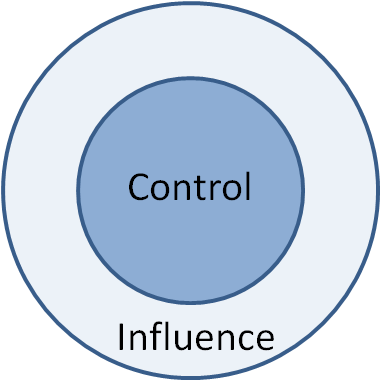
To take charge of your life, focus on controlling what you can.

As a practical matter, there’s not much you can control. So, you might as well control what you can.

You cannot control:

  • How other people treat you
  • How other people respond to you
  • What other people say
  • The weather
  • Company policies (for many people)
  • Laws (again, for most people)
  • etc.

You can control your own words, actions, reactions, and interactions.

That’s it.

When I discuss this idea in training, I often say that of the 6+ billion people on the planet I can only control one of them. And he doesn’t always cooperate with me.

Still, controlling myself is all I’ve got.

For example, I can’t control whether or not people read this blog. I can control how often I post.

I can’t control if people treat me with respect. I can control if I treat them with respect.

And, the list goes on in like manner.

The point is this:

By focusing on what I can control, I become less concerned with what I cannot control.

With this as my focus, I can take charge of my life. You can choose to do the same.

This article is from the Take Charge series. Use the links below to read more from this series.

1 Categories : Personal Change, Reflections

If you’re willing to listen, you can learn all sorts of lessons from all kinds of people.

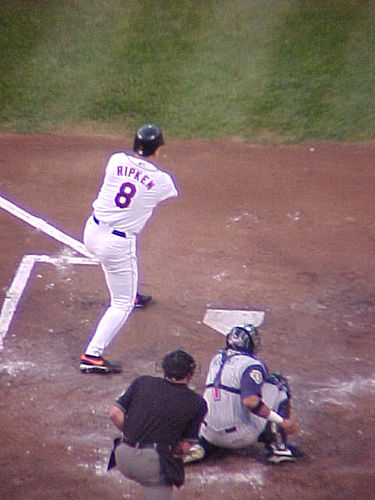
Today, I had the chance to see Cal Ripken, Jr speak at a conference in Baltimore, Maryland. Just in case you don’t know him, he played many seasons with the Baltimore Orioles baseball team. He holds the Major League Baseball record for the most consecutive games played (2632).

He spoke about his personal perspective on perseverance and success. At one point, speaking about the need to continually learn, grow, and improve, he said:

The ones who become satisfied with who they are have short careers.

What a powerful way to make the point about the need to constantly invest the effort to become better. He was speaking specifically about baseball players, and the lesson applies to all of us: leaders, team members, co-workers, parents, and spouses.

I encourage you to take this wisdom to heart and to commit yourself to lifelong, personal growth.

Photo by dbking.
0 Categories : Personal Change, Reflections