Archive for understanding

Have you ever taken an action – either immediately or at some later time – based on what you heard someone say only to find out after you acted (or spoke) that you did not accurately understand their statement or request?

So far, everyone I have asked this question in a face-to-face conversation answers pretty much the same way. In effect, they all say: “Yes, of course I have.” And, the truth is, so have I.

As the Irish playwright, George Bernard Shaw, said:

“The single biggest problem in communication is the illusion that it has taken place.”

The illusion that you accurately understand another person’s intended message based solely on your interpretation of his words, tone and body language is a trap that can hinder your desire to become a truly remarkable communicator. You certainly have an interpretation of what he intended to say, and you never really know if you understand correctly until you confirm it with him. Confirming mutual understanding is the feedback loop often missing in situations that lead to misunderstanding and frustration.

When you develop the ability to check your own understanding of the messages you interpret from what another person says by consciously inserting a feedback loop, you improve the odds of effectively communicating with her. Well phrased confirmation questions can help you do this gracefully and with ease to improve the odds that you get positive replies rather than snarky comebacks.

Here are five ways you can phrase a confirmation question:

  •  “Let me say back to you what I think you just said, so that I can be sure I understood you correctly…”
  • “Please correct me if I am wrong. I understood you to say ________. Is that correct?”
  • “If I hear you correctly, you are saying _____________. Is that right?”
  • “I hear you saying ____________. Is that right?”
  • “It sounds to me like you feel/think ____________. Did I understand you correctly?”

If you look closely at each question, you will see a common thought:  if a miscommunication happened, it’s my problem and not the other person’s.

You can probably find other ways to express the same idea, and I encourage you to do so. You do not want to say the same thing over and over again in the same conversation to the point that you sound like an inauthentic automaton.

This list is a good place to start your own list of confirmation questions.  I suggest that you think of others to add to your communication toolkit so that you can have many of them to pull on when you find yourself in the middle of a high-stakes conversation.

If you have other ways of confirming that you understood correctly, please add them in the comments section below.

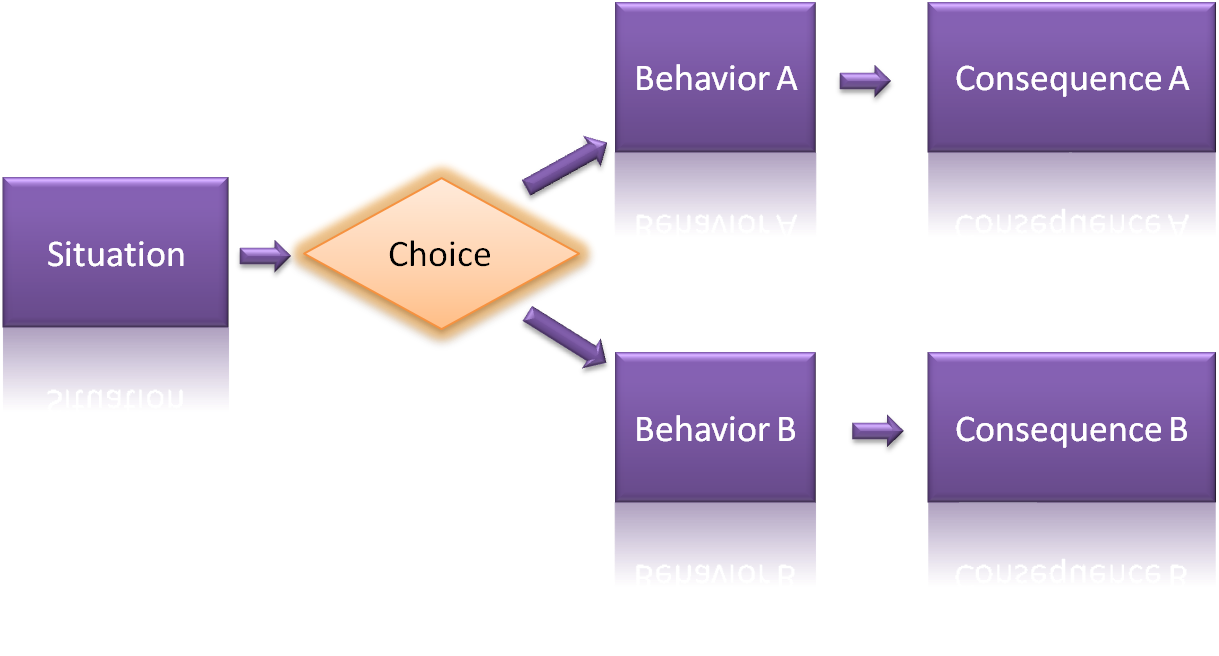
The diagram above shows a simplified model for better understanding what drives behavior.

Since people often spend their lives studying and understanding what really drives our behavior, I am pretty confident that I cannot hope to fully cover the topic in this short post.

I can provide a quick overview you can use to diagnose what’s happening in your interactions with other people and how you might be able to modify your approaches to get better results, have more fun, experience more satisfying relationships, and make sense of what you see people do.

Here’s a simplified description of what the model shows:

  1. We enter a situation.
  2. We anticipate the outcome we want from that situation.
  3. We choose the behavior that (we hope) gives us that outcome.

This description leads to the following implication:

We choose our behaviors based on what we expect to happen after we do them.

The consequence is what we expect that we will experience as a result of our behaviors. In this context, a consequence is anything that we experience as a result of our behavior. A consequence might be some external thing we receive or get because of our behavior. A consequence can also be the feelings we get from the behavior.

As you might guess, we tend to avoid negative consequences and to pursue positive consequences.  As a result, negative consequences (like punishments) tend to discourage repeating behaviors and positive consequences (like rewards) tend to encourage behaviors to repeat in the future.

Part of the challenge with applying this model in practice comes from a common error known as perception error. Perception error happens because not every person sees every consequence the same way. What one person sees as a reward; a different person might see as a punishment.

You can use the  DISC model to gain insights to avoid perception error.

For example, public recognition might be a reward for an outgoing, people-oriented person and it might be a punishment for a reserved, people-oriented person.

You can also apply the 5 Be’s of Motivation as you work with other people to encourage better interactions and results.

Remember, this is a very quick, very simplified description of this model and it’s implications. I’ll offer more insights in future posts.

A Question to Ask of Yourself:
How do I better control myself?

I often hear people ask questions about the DISC model that indicate a desire to use the model to somehow change others.

Rather than using the model to label, categorize, or stereotype people, I suggest a different approach: use the DISC model to find ways to connect with other people in better, more effective ways.

Towards that end, one question that I suggest you ask yourself is this:

How can I use the DISC model to better understand other people and change my behaviors so that I communicate more clearly?

My message is pretty simple: get over yourself.

Learn to adjust and modify your words and actions so that they are heard and understood more quickly and more clearly by other people.

This is what I strive to do every day. I’m not perfect by any stretch of the imagination. The more I work at it though, the better I get. And you can do it, too.

Do this, and you will significantly improve your effectiveness as a leader, team member, or parent.


Free DISC Profile

0 Categories : DISC Model, Video

Wonder

As I read about, study, and work to apply effective conflict resolution techniques, I see one common and overwhelming problem develop in workplaces, families, and social organizations. I see the same problem develop just about everywhere I see people interact.

What is this huge problem?

People make assumptions about other people’s intentions.

Sadly, they often make wrong assumptions about the other person’s intentions.

This behavior is so common and so prevalent, I have written about it on at least two other occasions.

In one post, I told the story of how I started down the path of wrong assumptions in an interaction with my daughter.

In another post, I shared an observation I made about an interchange where one person based their entire interaction with another person on their assumptions about the other person’s intentions without ever asking for clarification.

Recently, I had the opportunity to observe another interchange between two people who got seriously engaged in a heated conversation because one of the parties took offense to what he believed to be the other person’s intentions. For the purposes of this post, let’s say their names are John and Joe.

In a small meeting setting, Joe raised a question about something John had proposed in a previous meeting. I heard Joe question the proposed approach to solving a problem. Apparently, John heard Joe question the necessity of solving the problem.

John’s body went almost immediately rigid as he turned to face and lean toward Joe. His voice tone grew sharp, and his volume went up. In all fairness to John, I don’t really know what he was thinking. I did perceive his tone and body language to become aggressive.

The conversation got progressively more heated as Joe and John spoke.

As they continued, John made direct, negative comments about his view of Joe’s intentions. He used words like:

  • “You just said that because you want to…”
  • “You didn’t have the courage to speak earlier about…”
  • “I knew you would do this to me…”

In rapid succession, John manged to:

  • Negatively label Joe’s intentions,
  • Attack Joe’s character, and
  • Express his view that Joe was doing something “to” him.

It only got worse from there, and it all began with John’s assumption about Joe’s intention.

John immediately assumed that Joe had a negative intention. His response followed the classic conflict escalation cycle almost perfectly. From this negative interpretation, he went to anger (my interpretation of his emotional state), and both parties found themselves locked in a negative conversational spiral.

Had John been willing to question his assumptions about Joe’s intention and then to engage in conversation and dialogue rather than in attack and recrimination, the situation would likely have gone in a totally different direction.

The next time you find your assumptions about another person’s intention leaning towards the negative, stop yourself for just a moment and question your assumptions.

  • Did they mean that as an attack or simply as a statement of their opinion?
  • Are they attacking my character or are they just trying to understand my approach?
  • Did they mean what I think they mean?

I’m sure you get the point. Take just a moment to slow down and question your assumptions before you dive into the conversation.

Photo by striatic.
1 Categories : Resolving Conflict

On two recent occasions, I have been involved in interactions that started with a minor miscommunication and quickly elevated to full-blown conflict. In both situations, the other person and I pretty quickly recognized what was happening, and we managed to get our communications back under control.

These situations caused me to reflect on what happens in conflict:

  • How it gets started,
  • How it escalates, and
  • What you can do to de-escalate it.

I was also wondering if these situations happen in your life. Here’s what I mean, you know what you should do in a given situation, the situation occurs, and then you do exactly the opposite of what you knew to do.

Since I’m guessing that I’m not alone in this struggle, I thought I would interrupt my series of posts on Frequently Asked Questions About the DISC Model by mixing in a few posts on understanding the dynamics of conflict escalation.

Using this post as a starting point, we can then look at how to avoid or minimize this problem in our lives.

In this post, I will quickly show a model of what often happens during conflict escalation. By understanding the model, we can plan positive steps to back conflicts down after they start. I’m drawing some of this post content from a video course I am developing on resolving personal workplace conflicts. I’ll share more on that later.

The escalation cycle generally starts with one person (I’ll call them Person A) doing or saying something that the other person (Person B) perceives as a threat. Notice the key word: perceives. It doesn’t really matter if Person A meant their words or actions as a threat. It only matters if Person B sees the words or actions as a threat.

This perception of threat can take many forms, and it is likely linked to the anger process I wrote about previously.

Once Person B perceives a threat, they will probably move to anger and then behave in a self-protective way out of that anger.

Person A now perceives Person B’s behavior as a threat.

Person A follows the same perception-anger-behavior pattern and further contributes to the conflict escalation as shown in the video above and the image below. (Click on the image for a larger view.)
I plan to revisit the specific things we can do to reverse this cycle in future posts. For now, I’ll leave you with this observation: either person can take steps to de-escalate the conflict.

They can either:

Recognize the problem and change their behavior so that the other person no longer perceives a threat.

— or —

Question their perception in order to get their own anger under control.

In practice, the person taking responsibility would likely do both.

In an ideal world, both parties would take responsibility, stop blaming, and move to resolution. Even in our less than perfect world, either party can take the right actions and move to resolve the conflict with or without the other person’s cooperation.

3 Categories : Resolving Conflict