Archive for Reflections – Page 2

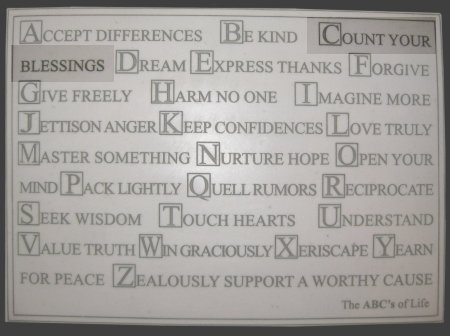
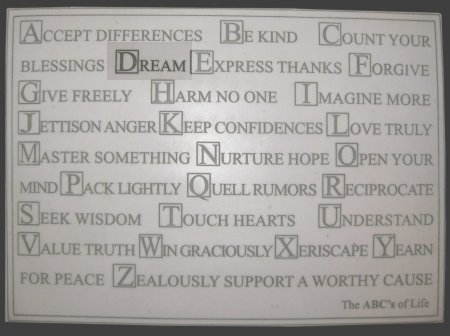
Count Your Blessings

Bad stuff happens to everyone.

We all face illness, the death of loved ones, financial crises, job setbacks, relationship challenges, and mechanical malfunctions. All of them are real, and all of them can breed frustration. When faced with these events, we often view them only in the negative context, and we ask the question: “Why me?”

Recently, I read a quote by the great tennis player Arthur Ashe:

If I were to say, “God, why me?” about the bad things, then I should have said, “God, why me?” about the good things that happened in my life.

— Arthur Ashe

If I understand correctly, he said this sometime after he was diagnosed with AIDS — after he was confronted with and had to live with “bad” news.

After this diagnosis, he went on to speak out for AIDS awareness rather than quietly retire to a private life.  Shortly before his death, he founded the Arthur Ashe Institute for Urban Health.  He kept using his blessings to help others even when he had received what many would call a curse.

Here’s what I propose, don’t ask “why” questions when confronted with adversity. Instead, ask “what” questions. Ask:

  • What lesson have I learned from this experience?
  • What will I do now?
  • What good is there in this situation?

“What” questions give you power. “Why” questions sap your strength.

And, I come back to the title of this post: Count Your Blessings.

Despite any hardship, all of us have some blessing.

If I have a co-worker who drives me nuts, I have a job. If my car has a broken water pump, I have a car. If my furnace breaks, I live indoors.  If I lose a loved one, I had the privilege of knowing them.

I do not suggest that counting your blessings during a crisis or hardship is an easy thing to do. Nor do I claim to always execute this thought perfectly.

I do know that when I have found the strength and wisdom to look past the challenge to see the blessing, the challenge seemed less daunting, and I had the energy to persevere. When I have focused on the challenge, I have felt hopeless and without energy.

So, to have energy, enthusiasm, and happiness — count your blessings.

This article is from the ABC's of Life series. Use the links below to read more from this series.

0 Categories : ABC's of Life, Reflections

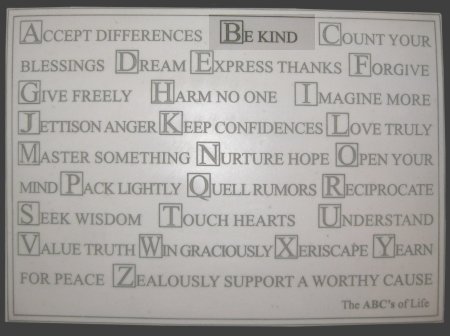
Be Kind

What a simple concept, and it is so often violated.

It does not seem that being kind should be difficult. Yet, I see examples of unkindness all around me.

  • Parents yelling at their kids.
  • Kids ignoring their parents.
  • Bosses interrupting employees.
  • Employees gossiping about their boss.
  • People cutting each other off in traffic.
  • Customers getting impatient with store employees.
  • Store employees failing to listen to customers.
  • And the list goes on.

It’s really not so hard to be kind. What is hard is remembering to do it when you are stressed, tired, rushed, or frustrated.

Today, my encouragement for you is to be kind.

Let someone go first at an intersection. Stop and listen to your employee, co-worker, spouse, or child. Let the person who is rude to you finish what they have to say. Take your neighbor’s garbage can to their garage. Hold the door for someone.

Do something today to be kind to another person.

I think it will make their day — and yours.

This article is from the ABC's of Life series. Use the links below to read more from this series.

0 Categories : ABC's of Life, Reflections

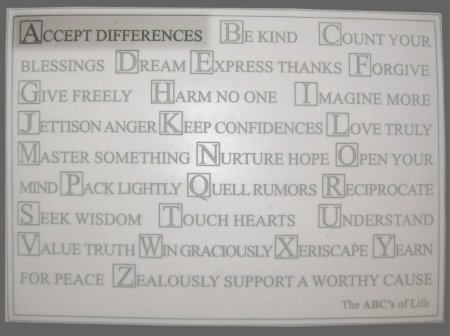
ABC's of Life - Accept Differences

During the week between Christmas and New Year’s day, my wife and I went to the Biltmore Estate in Asheville, North Carolina. Near the end of the day, we stopped in one of the gift shops, and we found the plaque shown in the picture with this post. We immediately loved it, and I knew that it would become the object of a series of posts inspired by the message on it. This is the first of those posts.

Accept differences. What a simple, yet powerful concept.

By accept differences, I do not mean tolerance. I have already written about why I don’t want to be a tolerant person.

When I say accept differences, I mean that I see the power in understanding how other people develop thoughts and feelings about certain topics that are different from my thoughts and feelings without lapsing into criticism, condemnation, and moral judgment about them as human beings.

As I see it, accept differences means that I can…

  • Accept the person even when I do not accept his ideas, thoughts, and beliefs
  • Be friendly, cordial, and respectful despite our different viewpoints
  • Work with someone to solve a problem even when we disagree about issues unrelated to the problem we are solving.

One day recently, my wife told a teenage girl that she disagreed with the teenager’s choice and the teenager replied: “Mrs. Harris, don’t be hatin’.”

Does disagreement really have to imply hate?

I do not think that my disagreement with a persons behaviors or choices means that I hate her, and I don’t believe that a person hates me simply because she disagrees with me.

Accept differences.

This article is from the ABC's of Life series. Use the links below to read more from this series.

3 Categories : ABC's of Life, Reflections

A few days ago, I posted about the tragic death of a young lady who was part of my life when I was in college and she was a toddler. You can read that post here.

Sadly, I was unable to attend her funeral. I learned of the accident that took her life late on Thursday night and the funeral was on Saturday. I live in Indiana, and her funeral was in North Carolina.

My inability to get to North Carolina to lend my support to people who were a big part of my early adulthood saddened me equally as much as hearing of Krystal’s death.

In reflecting on the events of the last few days, I see that the problem is one of margin.

To explain what I mean, I’ll lean on my background as an engineer.

In my engineering design classes, I learned about the concept of design or safety margin — a factor built into design calculations to allow for minor errors, miscalculations, under estimations, and other variables that are difficult to accurately determine.

While I was in the Navy and learning to become an Engineering Officer, I learned about the specific margins that were built into both the submarine and the engineering plant to ensure safe operation.

Later, when I was working as a research engineer in the chemical industry, I used the concept of design margin as I developed new products and worked with customers to get our products qualified for their applications.

Safe engineering design always considers, allows for, and builds in some margin for safety.

This weekend, I became eminently aware of the lack of margin in my life. I didn’t have enough time margin to safely make the 12-hour one-way drive in the time I had between learning of Krystal’s death and her funeral. I didn’t have enough financial margin to jump on a plane and go.

Do I have enough time to live up to my immediate commitments? Yes. Do I have enough financial margin to meet my financial obligations? Yes.

And having enough to meet the minimum requirements does not create margin.

Just as the concept of margin applies to our schedule and our budgets, it also applies to our personal and professional relationships. For example, do you have enough margin in your relationships to…

  • Withstand a communication error?
  • Make it through a misunderstanding of intention?
  • Survive a missed appointment?
  • Last beyond a forgotten task?
  • Etc.

I don’t propose that I have a “silver bullet” answer for creating more margin. I do find myself thinking about it a lot the last few days.

I suppose that each person has to find his own way to create margin in his life. So, as we prepare to end 2010 and begin 2011, I’ll share the question with you that I’ve been asking myself:

What will you do, starting now, to create more time, financial, and relationship margin in your life?

This is a big question to consider, and it relates directly to how you set your goals for next year.

If you have suggestions for me or others reading this post that might help in this process, please leave a comment below.

If you have specific questions about setting better goals, my friend and colleague, Kevin Eikenberry, is leading a free teleseminar on December 21 to address goal setting issues. You can leave your question for him and register here.

8 Categories : Reflections

On Thursday December 9, a dear friend of mine lost her niece, Krystal, in a traffic accident.

I won’t go into the details of our thirty year friendship other than to say that my friend’s niece was important to me. So, I was, and am, sad.

This post is, in one way, a tribute to a young life that ended too soon at 28 years old. And, in another way, it’s a reminder to treasure and protect your relationships.

I knew Krystal well while I was in college at N.C. State. I met her when she was an infant, and I had several opportunities to take care of and play with her as she became a toddler.

It was around this week about 27 years ago that I watched her while my friend and her sister went Christmas shopping. I remember that Krystal was teething, we ran out of Anbesol, and I didn’t have a car seat with me so that I could take her with me to go get more. I sat in a chair and held her for the better part of 3 or 4 hours even though I had homework to do. It was a terrible night that I remember fondly.

When she was about 2 or 3, I built Krystal a toy box with her name on the front in hand-cut wood letters. When I spoke with my friend on Thursday, I learned that Krystal still had that toy box in her home. That, too, was a happy memory.

Shortly after building the toy box, I entered the Navy and my life went away from North Carolina.

I’m sure that I saw her again when I visited my parents on trips home while I was stationed in Charleston, South Carolina, but no particularly notable event happened that I recall right now.

Over the the next 15 or 16 years I got married, and I had my own kids. I still thought of Krystal often, I just didn’t get back to Raleigh to reconnect with my college and high school friends and their families after my parents moved from there.

The last time I saw Krystal, she was around 20 or 21 years old. I was in Raleigh to do a workshop. I was only in town for one night, and she made a point of coming to see me for a brief visit. It wasn’t a big thing except that she made the effort, and it meant a lot to me.

I’ll likely be in Raleigh next summer to do another workshop. Looking ahead at my 2011 calendar, I have been hoping to plan an extra day or two while I’m in town to do some reconnecting. Krystal was high on my short list of people I would love to see. Now, I won’t get that chance.

Over the last few days, I keep remembering the words of the song Blink by the group Revive. And that’s the life lesson that goes with this post. Rather than tell you the words, I thought I would ask that you take the 4 minutes it takes to watch the video.

It’s powerful, and it sums up much of what I’m feeling and thinking as I remember Krystal.


Blink by Revive

1 Categories : Reflections

To take charge of your life, focus on controlling what you can.

As a practical matter, there’s not much you can control. So, you might as well control what you can.

You cannot control:

  • How other people treat you
  • How other people respond to you
  • What other people say
  • The weather
  • Company policies (for many people)
  • Laws (again, for most people)
  • etc.

You can control your own words, actions, reactions, and interactions.

That’s it.

When I discuss this idea in training, I often say that of the 6+ billion people on the planet I can only control one of them. And he doesn’t always cooperate with me.

Still, controlling myself is all I’ve got.

For example, I can’t control whether or not people read this blog. I can control how often I post.

I can’t control if people treat me with respect. I can control if I treat them with respect.

And, the list goes on in like manner.

The point is this:

By focusing on what I can control, I become less concerned with what I cannot control.

With this as my focus, I can take charge of my life. You can choose to do the same.

This article is from the Take Charge series. Use the links below to read more from this series.

1 Categories : Personal Change, Reflections

Last week, I listened to a speaker talk about the necessity of becoming clear on your purpose if you want to achieve success. It was a message that resonated with me, and it triggered some thoughts about my business and my relationships.

As I reflected on what he had to say and I considered some of the questions I receive in workshops, seminars, teleseminars, and coaching calls, I realized that part of what I hope to accomplish with my work is to help people get free of thoughts, attitudes, and behaviors that trap them in bad situations — bad work relationships, bad personal relationships, bad partnerships, etc.

So, I’m starting a series of articles targeted at specific things you can do to take charge of your life. I haven’t mapped out a detailed plan at this point. The series might be 6 articles or 16. I don’t know right now. I’m just going to write them and keep adding to the series until it is finished.

The general principles that come to mind as I start are:

  • Control what you can
  • Influence who you can
  • Forget about the things and people you can neither control nor influence
  • Stay focused on what you can do rather than what you can’t do
  • Take responsibility for your situation.

I might think of some others as the series progresses. I would certainly be open to input on what to include on this list. Please let me know if you see a core, guiding principle for taking charge of your life that I missed.

The general principles are sort of like the airplane control panel in the picture above. They give you a way of looking at and evaluating your life to see what you either need or want to change. I’ll be exploring each of them individually and some related ideas in future articles. I hope you’ll stop by again and check the series out as it unfolds.

Photo by Blyzz on Flickr.

This article is from the Take Charge series. Use the links below to read more from this series.