Archive for Personal Change

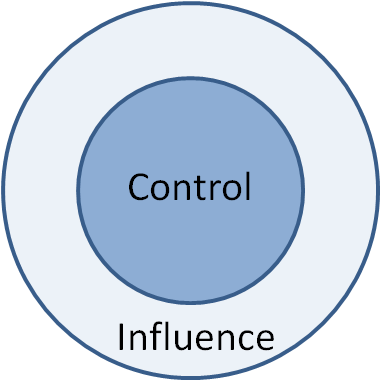
To take charge of your life, focus on controlling what you can.

As a practical matter, there’s not much you can control. So, you might as well control what you can.

You cannot control:

  • How other people treat you
  • How other people respond to you
  • What other people say
  • The weather
  • Company policies (for many people)
  • Laws (again, for most people)
  • etc.

You can control your own words, actions, reactions, and interactions.

That’s it.

When I discuss this idea in training, I often say that of the 6+ billion people on the planet I can only control one of them. And he doesn’t always cooperate with me.

Still, controlling myself is all I’ve got.

For example, I can’t control whether or not people read this blog. I can control how often I post.

I can’t control if people treat me with respect. I can control if I treat them with respect.

And, the list goes on in like manner.

The point is this:

By focusing on what I can control, I become less concerned with what I cannot control.

With this as my focus, I can take charge of my life. You can choose to do the same.

This article is from the Take Charge series. Use the links below to read more from this series.

1 Categories : Personal Change, Reflections

Last week, I listened to a speaker talk about the necessity of becoming clear on your purpose if you want to achieve success. It was a message that resonated with me, and it triggered some thoughts about my business and my relationships.

As I reflected on what he had to say and I considered some of the questions I receive in workshops, seminars, teleseminars, and coaching calls, I realized that part of what I hope to accomplish with my work is to help people get free of thoughts, attitudes, and behaviors that trap them in bad situations — bad work relationships, bad personal relationships, bad partnerships, etc.

So, I’m starting a series of articles targeted at specific things you can do to take charge of your life. I haven’t mapped out a detailed plan at this point. The series might be 6 articles or 16. I don’t know right now. I’m just going to write them and keep adding to the series until it is finished.

The general principles that come to mind as I start are:

  • Control what you can
  • Influence who you can
  • Forget about the things and people you can neither control nor influence
  • Stay focused on what you can do rather than what you can’t do
  • Take responsibility for your situation.

I might think of some others as the series progresses. I would certainly be open to input on what to include on this list. Please let me know if you see a core, guiding principle for taking charge of your life that I missed.

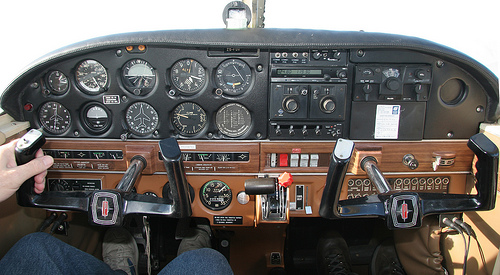
The general principles are sort of like the airplane control panel in the picture above. They give you a way of looking at and evaluating your life to see what you either need or want to change. I’ll be exploring each of them individually and some related ideas in future articles. I hope you’ll stop by again and check the series out as it unfolds.

Photo by Blyzz on Flickr.

This article is from the Take Charge series. Use the links below to read more from this series.

If you’re willing to listen, you can learn all sorts of lessons from all kinds of people.

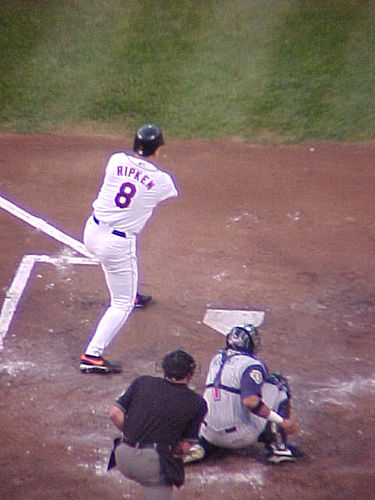
Today, I had the chance to see Cal Ripken, Jr speak at a conference in Baltimore, Maryland. Just in case you don’t know him, he played many seasons with the Baltimore Orioles baseball team. He holds the Major League Baseball record for the most consecutive games played (2632).

He spoke about his personal perspective on perseverance and success. At one point, speaking about the need to continually learn, grow, and improve, he said:

The ones who become satisfied with who they are have short careers.

What a powerful way to make the point about the need to constantly invest the effort to become better. He was speaking specifically about baseball players, and the lesson applies to all of us: leaders, team members, co-workers, parents, and spouses.

I encourage you to take this wisdom to heart and to commit yourself to lifelong, personal growth.

Photo by dbking.
0 Categories : Personal Change, Reflections

Get ready, this is a bit of a rant.

Nothing happened to set me off. There was no “precipitating event” this morning.  This is just a frustration of mine that has been building for some time. Ready? Here goes…

Why do we blame other people when we don’t do everything we can do to fix or change a bad situation?

Parents blame teachers and teachers blame parents for poor test scores. Managers blame employees and employees blame managers for poor business results. Parents blame teenagers and teenagers blame parents for misunderstandings.

I completely support the idea of holding people accountable for their words, actions, and responsibilities. I believe that people are responsible for both their actions and their failures to act.

I also believe that you cannot hold someone else accountable if you have not, first, done everything in your power to fix the situation.

Doing my part has nothing to do with you doing your part. It’s my responsibility to do everything in my power to make things better whether you choose to cooperate with me or not.

The moment that I make my contribution to making things better contingent on you doing your part, I abdicate my responsibility.

Yes, I understand that people get frustrated and give up when other people don’t eventually cooperate. I get that.

I’m not suggesting that we should keep pursuing relationships that have no hope of reciprocal effort or that we continue to work in environments that are toxic or dangerous (either emotionally or physically) beyond our ability to change them.

I am suggesting that we make sure we have done whatever we can do before we even begin to think about pointing our fingers at other people.

Here’s my personal responsibility pledge:

From this day forward, I pledge to always give my best and fullest effort to a business, organization, cause or relationship that I am involved in before I start blaming other people for its failure.

Will you join me today in taking the personal responsibility pledge?

Photo by MShades.
0 Categories : Personal Change, Reflections

Whose fault is it when you lose? Whose credit is it when you win?

In this time of Olympic competition, I wonder about these sorts of questions.

Evan Lysacek beats Yevgeny Plushenko by playing the scoring system to its fullest, and he wins. Then Plushenko plays the victim. In my opinion, he lost – end of story.

Maybe Plushenko is more daring. Maybe he is the better physical skater. Maybe the scoring system should reward the quad more highly than it does. Maybe the system should be changed to better reward risk and daring.

These issues are far beyond my knowledge of skating. I don’t know how to address the systemic issues. I do know that Lysacek understood the rules of the game he was playing better than Plushenko. Lysacek applied the rules to his program, and he was the victor.

Now Plushenko plays the victim and cries foul. Well, he’s a poor sport as far as I’m concerned. Plushenko blames, criticizes, and ridicules Lysacek. Is it Lysacek’s fault that Plushenko didn’t know how to play the game? I don’t think so.

It’s not Lysacek’s fault that Plushenko didn’t plan his program to take full advantage of his athletic ability to gain as many points as possible. The fault is Plushenko’s.

What, you might ask, has any of this got to do with the topic of this blog?

The answer: it’s about personal responsibility.

When we blame our circumstances or outside factors for our behaviors, we abdicate responsibility for our actions. We give away the only control we really have – the control over our words and actions.

Earlier today, I read a post by my friend and colleague Kevin Eikenberry titled: Who Is Responsible, Really? In his post, he calls it a rant, he makes an argument for why we need to take personal responsibility for our actions. I could not agree more.

Do outside events affect us and drive our behaviors to a certain extent? Of course they do.

Do other people’s behaviors affect us and our emotions? Of course they do.

Do we often overlook the influence of environmental factors when evaluating the behaviors of others (Fundamental Attribution Error)? Absolutely we do.

None of this takes away from the point of this post: If we want to win, we have to take responsibility for ourselves. If we want to be great communicators, leaders, parents, spouses, friends, family members, and co-workers; we have to take responsibility for ourselves.

Playing the victim, blaming others, and looking for others to fix our situation are futile efforts. As I heard in the Navy, you need to “man up” if you want to win.

Just for comparison, take a look at the definitions of victim and victor:

vic·tim (n.)1

  1. One who is harmed or killed by another: a victim of a mugging.
  2. A living creature slain and offered as a sacrifice during a religious rite.
  3. One who is harmed by or made to suffer from an act, circumstance, agency, or condition: victims of war.
  4. A person who suffers injury, loss, or death as a result of a voluntary undertaking: You are a victim of your own scheming.
  5. A person who is tricked, swindled, or taken advantage of: the victim of a cruel hoax.

vic·tor (n.)2

One who defeats an adversary; the winner in a fight, battle, contest, or struggle.

External events can happen outside my control. Other people may treat me in ways that I cannot control. Economic turmoil and business conditions are usually beyond my control. Winning or losing a particular event, situation, or circumstance might be beyond my control.

Thinking like a victor or a victim is in my control. Victors defeat adversaries. Victims have no control. In the battle to become a better parent, leader, spouse, and co-worker; the battle is with myself. The battle is to overcome my own self-limiting thoughts and emotional responses.

There is no Fundamental Attribution Error when I evaluate myself. There is either the honesty to confront my failures and to learn from them or the dishonesty of blaming others when I didn’t control myself.

Plushenko didn’t learn the rules of the game well enough. He did what he wanted to do rather than what would bring him victory. Lysacek played the game based on the rules as they were given to him.

In working with people, we can either try to change human nature, or we can learn to work with it. We can say that people shouldn’t behave the way they do, or we can learn to understand the way they do.

I cannot control how other people behave. I cannot control many circumstances and events. I can control how I respond to them.

In working with people, you can take the Plushenko approach (this is how it should be) or the Lysacek approach (this is how it is). Plushenko lost. Lysacek won.

In the battle to make yourself a better person, you can be either a victim or a victor. You can’t be both. The choice is yours.

Photo credit: http://www.flickr.com/photos/eyesplash/ / CC BY 2.0

1“victim.” The American Heritage® Dictionary of the English Language, Fourth Edition. Houghton Mifflin Company, 2004. 20 Feb. 2010. <Dictionary.com http://dictionary.reference.com/browse/victim>.

2“victor.” The American Heritage® Dictionary of the English Language, Fourth Edition. Houghton Mifflin Company, 2004. 20 Feb. 2010. <Dictionary.com http://dictionary.reference.com/browse/victor>.

0 Categories : Personal Change, Reflections