Archive for employee motivation

There are two musical instruments I would like to play. One is the saxophone and the other is the guitar.

When I was in the fifth grade, my parents placed an order to rent a saxophone for the following school year so that I could join the band and learn to play. Over the summer, we moved to a different city where band started in fifth grade. I was out of sequence with the school system, and I wasn’t able to take private lessons.

I didn’t learn to play the saxophone that year.

Somewhere in my teen years, I thought about playing the guitar. I eventually got one — I think I was about 18 or 19. It sat in my closet until I was in the Navy and I had a roommate with a guitar.

With my roommate’s coaxing  and help, I learned to play — a very little bit. We were assigned to different submarines, and I put down the guitar. I have no idea where that guitar is or what happened to it.

That was about 25 or 26 years ago.

This past Christmas, my youngest daughter asked for a guitar, and she got one.

She will be leaving home this fall to attend the residential honors high school that her older sister graduated from a few weeks ago. In short, both of my girls will be out of the house starting in August.

As I thought about my youngest daughter leaving home to attend school, it occurred to me that she would only be with me full-time for about eight more months. If I wanted to do something with her to build memories and relationship, the time was short.

When she got her guitar, I also thought about my goal of learning to play the guitar.

Suddenly, the goal that first surfaced over 30 years ago had a new meaning.  It was now about something I could do with my daughter.

The “why” of the goal moved from the sort-of-a-neat-idea category to the I’ve-got-to-do-it-now-because-it’s-very-emotional category.

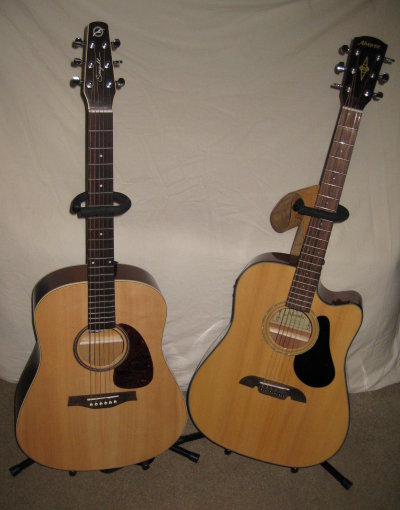
The guitars in the picture with this post are ours. My daughter’s is on the right. Mine is on the left.

For leaders of any kind — managers, supervisors, business owners, coaches, teachers, or parents — the lesson in this story is key to understanding what might motivate someone to take action.

It’s the “why” not the “what” that gets people moving.

I had a new guitar in my home as quickly as I could make it happen when the emotion behind the goal got big enough. That emotion wasn’t about money, recognition, or any other externally applied consequence.  And buying the guitar was not, ultimately, about the guitar. It was about time with my daughter and memories.

When you find ways to communicate with people about issues bigger and more emotional to them — to them is the key point here — they will move to action to accomplish the goal.

I am not suggesting that external motivators have no impact.

I am suggesting that looking for the personal, emotional hook and clearly communicating the connection between the task or goal and that emotional hook will get you more high-energy, discretionary effort than anything else you can do as a leader.

In a  post about finding what motivates other people, I shared some insights that might help you in the process of finding that emotional hook. It’s not always easy. It can often be done.

By the way, I still don’t own or know how to play a saxophone. I guess the “why” isn’t big enough yet.

In previous posts, I have written about a model for understanding what motivates behavior and three clues you can use to find what motivates another person.

Today, I’ll share some quick insights about what motivates people based on their DISC behavioral style.

A person who has outgoing and task-oriented (Dominant) traits is often motivated by:

  • Solving problems
  • Conquering challenging situations
  • Getting results

And they will often prefer to work at a fast pace with a focus on quick results and direct action.

A person who has outgoing and people-oriented (Inspiring) traits is often motivated by:

  • The opportunity to interact with others
  • Public recognition
  • Varied activities

And they will often prefer to work at a fast pace with a focus on doing things in a fun way that does not require high attention to detail.

A person who has reserved and people-oriented (Supp0rtive) traits is often motivated by:

  • Teamwork
  • The opportunity to help others
  • Feeling appreciated for their contribution

And they will often prefer to work at a steady pace with a focus on doing the work process in a way that minimizes risk and strengthens relationships.

A person who has reserved and task-oriented (Cautious) traits is often motivated by:

  • Structuring or organizing things
  • Researching or searching for information
  • Finding the “right” solution for a problem

And they will often prefer to work alone with a focus on details and proper structure.

As you work to apply this information in your personal and professional life, remember that people have varying degrees of all of these traits in their behavioral style blends and that you are likely to observe at least two of the four styles to a significant degree in most people.

The information in this post is only intended to give you a basic framework for understanding what might motivate another person. It is not intended as a complete and exhaustive description of how the DISC model might reveal motivational patterns and preferences.

1 Categories : Leadership Skills, Parenting

Many leaders struggle with finding ways to motivate people to higher level performance.

I have already written that you cannot motivate another person. So, let’s set aside the idea that the leader provides the motivation and move on to the idea that a leader can learn to identify the things that do motivate the people on his or her team.

In previous posts, I wrote about Three Clues You Can Use to Find What Motivates Another Person and A Simple Model for Understanding What Drives Behavior. In this post, I’m offering a thought to expand the idea that you can look at a person’s hobbies and interests to find clues about what motivates him and then apply that insight as you assign and delegate tasks.

Current motivation research, like the research Daniel Pink shares in Drive: The Surprising Truth About What Motivates Us, indicates that excessive reliance on extrinsic motivators — rewards, praise and prizes — can eventually have a negative impact on overall motivation.

A quick look at the model I shared previously could lead to the conclusion that the consequences referenced in that model refer only to externally applied rewards, prizes, bonuses, recognition, etc.

A deeper look reveals that a consequence is anything a person experiences as a result of her behavior. So, the emotions and personal satisfaction that people experience from their behaviors can be consequences that drive behavior. These emotions fall into the category of intrinsic rather than extrinsic motivators, and it is these emotions that people’s hobbies often reveal.

For example, I like woodworking, writing, building websites, working on my house, landscaping, and cooking. These activities show that part of what motivates me is analyzing and solving problems. When I do things that give me that opportunity, the work itself becomes a motivator because it gives me the emotional satisfaction of analyzing and solving a problem.

These hobbies also reveal that I tend to like working alone. I can (and do) call on customers and socialize with people. However, these activities are work to me.

My hobbies are play to me.

Work tires and play energizes.

A wise leader hoping to “motivate” me to higher performance would, as much as possible within the confines of the business need, give me assignments that maximized my ability to analyze and solve problems.

As you look for what motivates your team members, remember to look at their hobbies and interests for clues you can use to work with them in a way that taps their intrinsic motivation as much as possible.

Side note – Parents can use this idea with their children as well. What activities energize your kids and which ones drain them?

0 Categories : Leadership Skills, Parenting

What creates engagement? How do you build it, spread it , and maintain it?

I don’t propose that I know the definitive answer to these questions. I do have an observation…

People get engaged and enthusiastic about something they believe in.

You’re probably thinking: “Really Guy. That’s all you’ve got?” And my answer is, pretty much.

It’s not really rocket science. It’s not a mystery. It’s not the Holy Grail. It really does exist. Engagement happens when people believe in what they are doing.

Without that belief, the work is only about the paycheck.

So, the follow-up question becomes, how do you create the belief that leads to engagement.

My answer to this question is also pretty simple: build relationships.

Here’s a quick story to illustrate my point…

It’s nearly 10:00 pm on a Sunday night, and I’m working to get everything ready for the official launch day, now two days away, for the book I co-authored with Kevin Eikenberry, From Bud to Boss: Secrets to a Successful Transition to Remarkable Leadership. While the picture above is not my desk — my desk is far to messy to show to the public right now — it does represent what’s going on in my workspace.

I have both my desktop and my laptop computers working. I’m converting video files on one and writing this post on the other. My whole weekend has been like this. I’m pretty well chained to my computers and my phone. There is a lot to do when you’re trying to successfully launch a book into the marketplace.

The surprising thing is not that Kevin and I, the authors, have been working almost non-stop on book launch activities since the middle of last week. You would expect the people with their names on the cover to have a heavily vested interest in the success of the book.

Here’s what is rather surprising: several other people have also been working with nearly the same intensity and focus.

And it’s not just the people close to us. We also have a very long list of bloggers, podcasters, promotional partners, and others rushing to get their blog post, audio, video, or article posted to help with our launch.

Buried in this experience is a great lesson for leaders who want to know how to create that magical ingredient of organizational success called “engagement.”

How did we create this engagement? What steps did we take? What activities happened?

It’s simple. We built relationships.

Yes, we did lots of technical work, writing, and web site building. And, in the end, it was relationships that created the engagement.

We built relationships using phone calls, Skype calls, emails, text messages, letters, tweets, blog posts, interviews, and meetings. On the surface, these activities seem to be about the book and “getting the word out.” In the end, the activities were about building relationships more than they were about getting our message out.

The relationships gave us the opportunity to share our excitement with others. The relationships built the bridge that let other people catch that excitement. The excitement built belief, and the belief built engagement.

The lesson for leaders? Start with relationships, and you’ll likely wind up with engagement.

Photo by Martin Cathrae.
0 Categories : Leadership Skills

I’ll leave the video to do the talking in this post. The ideas that Dan Pink presents are definitely worth considering. I suggest leaders (including parents) should learn from this talk and find ways to apply the concepts to their situations.

1 Categories : Leadership Skills, Video