Archive for DISC Model

The video pretty much says it all for this post. It quickly gives you four steps for applying the DISC model for success with others.

In a nutshell, the four steps are…

  1. Understand the DISC model
  2. Understand your style (where you fit in the model).
  3. Understand the other person’s style (where they fit in the model).
  4. Adjust your words, behaviors, and tone to best fit how they receive information.

The video is about 7 minutes long.

If you would like insights for how to apply these four steps better, you can check out my Connecting With People and DISC Model FAQ’s post series. For even deeper insights, check out my products. If you really want to master these four steps, take a look at The Ultimate Communicator Workshop.

Today, I led a DISC communication skills workshop that ended with a role-play exercise to allow participants the opportunity to practice the skills we had been discussing.

For many of the people in the class, this was their first in-depth exposure to the DISC model and how to use it to more effectively communicate with others. The class was lively, engaged, and energetic with everyone in the room displaying a highly positive approach to learning. And, the role-play exercise brought to the surface a common frustration many people feel as they learn to apply the concepts I teach for becoming a better communicator.

As people attempted to “put on” the style of another person during the role-play, many of them felt awkward. Their role-play partners sensed this awkwardness. As a result, the participants attempts to connect with people with a different natural behavior style actually decreased the connection between them rather than increasing it.

They were frustrated. I was encouraged.

I was encouraged because they were making a genuine effort to connect with other people in a way that would make the recipient of the communication attempt feel most comfortable. Even though the results were not all that great initially, the effort to bridge the difference gap encouraged me.

They saw their efforts as failures. I saw their efforts as natural parts of the learning process.

A model for learning I often use speaks of learning happening in four stages:

  1. Unconscious incompetence
    The “I don’t know that I don’t know” stage.
  2. Conscious incompetence
    The “I realize that I don’t know something” stage.
  3. Conscious competence
    The “I understand how to do this, and I have to think about it to make it work” stage.
  4. Unconscious competence
    The “this has become natural to me and I don’t have to think about it any more” stage.

In attempting to apply the learning from the session, they were confronted with both the difficulty and awkwardness of learning to apply a new skill.

When I talked with them about the skills and they asked me questions, my answers seemed rather simple and effortless to them. For me, the answers were simple and effortless. In many situations, I have achieved (after much struggle and many failures) the unconscious competence level of learning for this material.

They are at the uncomfortable level of learning somewhere between conscious incompetence and conscious competence.

To break through this frustration, I encouraged them to keep at it even though the communication approach felt odd. I also encouraged them to seek feedback from other people about how their communication efforts were progressing. For example, I told people with Dominant traits to seek feedback from people with Supportive traits and vice-versa.

If you want to master using the DISC model to become a better communicator, I encourage you to do the same thing. Keep practicing and getting feedback on your efforts. You will eventually break through the awkwardness of trying to put on another person’s communication style to the comfort of authentically communicating by understanding their communication style.

Refrigerator

The DISC Model of Human Behavior is, as the name implies, about behavior. And, to apply it well, I suggest looking beyond behavior to the needs behind the behavior to really use it to connect and communicate with other people more effectively.

To illustrate the point, consider the refrigerator shown above. While this one has no food in it, I imagine you can think of a time when you opened a refrigerator door to check the contents. I also imagine that many of the times when you have stood with the door open were times when you were hungry and looking for food.

Looking in the refrigerator (the behavior) was the expression of an unmet need (you were hungry).

And, if you found an empty refrigerator enough times, you just might decide to escalate your behavior by leaving your house to get food.

People tend to behave in ways that get their needs met. When their needs are unmet, they will continue escalating their behaviors in an increasingly intense effort to meet their needs.

Food is a physical need, and we will act to get food when we do not have it. Likewise, we all have certain emotional/psychological needs, and we also act to get them met.

The DISC model is one tool that you can use to get an estimate of another person’s emotional/psychological needs so that you can take positive, intentional actions that increase your ability to effectively connect and communicate with him or her.

I only plan to hit some high spots with this post, and I certainly do not want to present this brief article as a comprehensive guide. There are many other factors to consider when it comes to understanding other people’s needs. And, the DISC model is still a good tool you can use to make an educated guess.

With that caveat said, here are some general needs you can consider as you work to understand yourself and others:

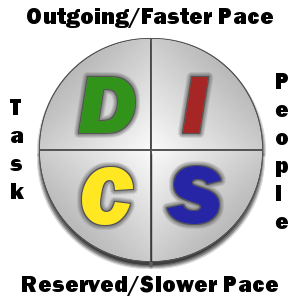
  • Outgoing, task-oriented, Dominant individuals often need:
    choices, challenges, and control.
  • Outgoing, people-oriented, Inspiring individuals often need:
    recognition,  approval, and admiration.
  • Reserved, people-oriented, Supportive individuals often need:
    appreciation, security, and assurance.
  • Reserved, task-oriented, Cautious individuals often need:
    quality answers, value and excellence.

When you work to understand these needs and to see other people’s behaviors through the filter of their needs rather than your own, you can make the adjustments to  your communication style that allows you to meet — or at least not challenge — another person’s needs so that you can create an environment for mutual gain.

Photo by RowdyKittens.


People frequently ask me why I use the DISC model in my work. Today, I’ll offer some of my reasons.

I use the DISC model because:

  • It is simple enough that…
    • I can work with someone for only a few minutes and help them gain perspective they have never seen before.
    • I can use it to help me when I am tired, stressed or angry.
    • I don’t need assessment results to understand another person.
  • It is descriptive enough that…
    • It helps me to see others more objectively and less subjectively.
    • It leads me towards understanding and away from judgment.
  • It is accurate enough that…
    • I can get a good guess about what someone wants from me when we communicate.
    • I can quickly understand another person’s perspective.
  • It is flexible enough that…
    • I can use it “on the fly” in real-life situations.
    • I can see the blends, subtleties and variations in other people’s perspectives without trying to force them neatly into a single box or label them.

Is the model perfect? No.

Does the model explain every nuance of human behavior? No.

Are there better clinical or analytical models? Yes.

Despite these limitations, for real-world, working-with-people-in-the-moment situations, it is the best tool for me.

These are the reasons that I use the DISC model.

Stressed Bird

You can use the DISC model to have some fun with other people by watching them stress out when you consciously communicate with them in a way that is different from their preferred style. It’s fun and easy to do.

Here are some tips to help you make this happen.

When you are communicating with…

…an outgoing, task-oriented, Dominant style person:

  • Speak slowly
  • Tell really long-stories
  • Give them lots of details they didn’t ask for
  • Avoid anything that even remotely resembles a decision or results-focused action.

…an outgoing, people-oriented, Inspiring style person:

  • Speak in a monotone, boring tone
  • Never smile, laugh, or indicate that you enjoy the conversation
  • Focus on data and details
  • Tell no stories and share no emotions

…a reserved, people-oriented, Supportive style person:

  • Speak quickly and loudly
  • Stand face-to-face and move your hands wildly while you speak
  • Push for quick results rather than listen to their concerns
  • Ignore how people feel about a situation

…a reserved, task-oriented, Cautious style person:

  • Tell stories with lots of emotional appeal
  • Try to get them to be “excited”
  • Attempt to persuade them before you have answered all of their questions
  • Focus on emotions over facts

The next time you want to frustrate another person, just remember these tips and consciously apply them to create an uncomfortable environment that encourages them to avoid you and disconnect from the conversation.

(This post is totally tongue-in-cheek. Hopefully, you see that I advocate doing exactly the opposite of what I have written here.)

Photo by David Friel.

Most of my writing about how to use the DISC Model to communicate more effectively has been focused on verbal communications. While the tips still apply to written communication, I haven’t written specifically about how to apply the model in emails and letters.

I might expand this thought further in later posts, but, for now, I thought I would share a quick tip to improve the odds that people actually read and take action on your written correspondence.

This tip is pretty simple and straightforward:

Put the main points and conclusions in bullet point or really short paragraph form at the top of the email and all supporting information below it.

Here’s my thinking on this tip.

Outgoing, fast-paced people don’t usually want to wade through the details to get to the conclusion. They will likely skim your email and then miss or misunderstand your point if you bury it towards the end.

Reserved, slower-paced people will probably want the supporting information. And, even they will probably skim the bullets first to decide if reading the details is worth their time.

Do your reader a favor, get to the point and then support it. Don’t build a case and then conclude.

(So, what if you need to build a case before you give a conclusion? If that’s your situation, I would question whether email was the best way to do that particular communication.)

Last week, I saw a report on television about the number of children that have likely been misdiagnosed as ADD/ADHD. As I watched the television piece, I was reminded of a common problem I see when people start to apply the DISC model of human behavior.

Here’s the challenge:

People often use disorder descriptions to speak about normal behavior.

The  most common misdiagnosis I have observed are:

D behaviors described as if they are indicative of Oppositional Defiant Disorder.

I behaviors described as if they are indicative of ADD/ADHD.

S behaviors described as if they are indicative of Social Anxiety Disorder.

C behaviors described as if they are indicative of Obsessive Compulsive Disorder (OCD).

While it might seem funny to some people to use the illness descriptions to speak about normal behaviors, I don’t really find it that humorous. In fact, I find it a bit offensive for several reasons:

  • Using illness descriptions to speak about normal behaviors minimizes the frustration and struggle of people who do have the psychological condition.
  • Using an illness description to speak about someone who does not have the illness implies that their behavior is, in some way, bad or wrong rather than just driven by different perspectives.

If you have read much of my writing yet, you know that I am a strong proponent of using the DISC model as a way to better understand how another person might see a situation and how I might best adapt to connect with them. I hope you also see that I strongly disagree with any attempt to use the model to label or artificially categorize people.

Generally, I have seen illness descriptions used by people to describe other people with the opposite style. For example, people with strong Cautious traits saying that people with strong Influencing traits are ADD/ADHD. Or people with high Inspiring traits saying that people with strong Cautious traits are OCD.

If you want to use the model to communicate more effectively, connect with others faster, and to build better relationships, I encourage you to beware of the temptation to use illness descriptions for any of the four primary behavior styles.